Did Jesus Christ die on a Friday (“Good Friday”), and rise on a Sunday (“Easter Sunday”)?
Is Easter Sunday “the Third Day” from “Good Friday”, according to the Scriptures?
Does it really matter?
The common teaching is that Jesus died on the Friday, before sunset and before the start of the Sabbath. This would make Friday the “first day”, even though Jesus died right at the end of it.
The next day was the Sabbath, the “second day”; the only complete day.
Then, Jesus was resurrected on the Sunday morning, the “third day”. It had to have been right at the start of the day, because Mary Magdalene and the other Mary found the tomb empty near dawn.
Matthew 28:1 – In the end of the sabbath, as it began to dawn toward the first [day] of the week, came Mary Magdalene and the other Mary to see the sepulcher.
Such is the common Christian tradition, fulfilling the Scriptures that give us, in our creeds, “the third day” on which Jesus rose from the grave. He did not remain in the grave for three days, but – based on this chronology – for slightly over one day.
There are several Scriptures that would allow for this interpretation, asserting simply that Jesus would rise on the “third day”. A search will reveal four places in Matthew’s gospel (16:21, 17:23, 20:19, 27:64), two in Mark’s gospel (9:31, 10:34), four in Luke’s gospel (9:22, 18:33, 24:7, 24:46), one in the Acts (10:40), and one in 1 Corinthians (15:4).
I acknowledge these Scriptures; I’ve read them, and I won’t refer to them again, though of course I shan’t ignore them.
Other Scriptures mention “in three days” (e.g. John 2:19), and “after three days” (e.g. Mark 8:31); however, the use of what is translated as “in” and “after” is not conclusive, to my understanding.
A more difficult Scripture to get around is found in Matthew’s gospel:
Matthew 12:39-40 – But He answered and said to them, “An evil and adulterous generation craves for a sign; and yet no sign will be given to it but the sign of Jonah the prophet; for just as Jonah was three days and three nights in the belly of the sea monster, so will the Son of Man be three days and three nights in the heart of the earth.”
There is absolutely no way to reconcile this to idea of burial on Friday evening and resurrection at dawn on Sunday. Jesus himself described it as the Sign of Jonah, and the timing would prove the fulfillment.
Jonah 1:17 – … and Jonah was in the belly of the fish three days and three nights.
Any way you try to make it fit, it will not work.
From a straightforward reading:
Friday night (Friday sunset to Saturday sunrise) – the first night
Saturday (Sunrise to sunset) – the first day
Saturday night (Saturday sunset to just before dawn on Sunday) – the second night
Sunday dawn – the second day if you really want to be loose with the term “day”
Here, there are only (at best) two days and two nights.
Jewish timing begins the day at sunset. Does this help?
Friday just before sunset – the first “day” if you want to be loose with the term “day”. This necessitates Jesus being in the “grave” before the completion of sunset.
Friday sunset to Saturday sunset – the first night and the second day.
Saturday sunset to dawn on Sunday – the second night.
Dawn Sunday – the third day (again, loosely) – but nowhere near the third night. Again, the women arrived just after dawn, yet this counts as a “day”.
Here, there are (at best) three days, but only two nights.
“Three days and three nights,” said Jesus. If he just meant “the third day”, or “within three days,” then why did he specify the three nights?
The solution
The solution is surprisingly simple. No Scriptures are contradicted, only the “Good Friday” teaching.
The problem is that, when Jesus died before the Sabbath (see John 19:31), the assumption is that Saturday is meant. Hence, says tradition, Jesus died on a Friday.
However, Jesus celebrated Passover with his disciples just before he was arrested. Passover is followed by a “High” day, also called a Sabbath day. So, for that week, there were two Sabbaths: one a High Day, and one on the regular Saturday.
The Evidence in the Gospels
Let’s see what actually happened, and how the Gospels tell us quite clearly when Jesus did die and rise again.
We know that Jesus celebrated the Passover with His disciples. What we now call “the Lord’s Supper” was the Passover meal, in which He identified Himself as the Passover sacrifice (Matthew 26:19ff).
Matthew 26:17-21 – Now on the first day of Unleavened Bread the disciples came to Jesus and asked, “Where do You want us to prepare for You to eat the Passover?” And He said, “Go into the city to a certain man, and say to him, ‘The Teacher says, “My time is near; I am to keep the Passover at your house with My disciples.” The disciples did as Jesus had directed them; and they prepared the Passover. Now when evening came, Jesus was reclining at the table with the twelve disciples.
The feast of Unleavened Bread started with the day of Preparation, on which the Passover meal was eaten (Exodus 12:18-20; Numbers 28:16-17). It was the fourteenth day of the first month (the 14th of Abib, now called Nisan), and could have fallen on any day of the week. It could have been a Friday, but it could as easily have been a Monday or a Wednesday.
Another thing to remember is that the Jewish days began at sunset, which tends to confuse us Westerners somewhat. Our day starts at midnight. So, the 13th of Abib became the 14th of Abib at sunset. We would not have flipped the calendar to the 14th until midnight, some six hours into the Jewish 14th.
The day after the day of preparation (the 15th) was a high day called a Sabbath. This was not the same as the seventh day Sabbath, but a holy day. Holy days were called Sabbaths and were treated as such, with all of the observances of any other Sabbath (Leviticus 16:31; 23:24-32, 39).
How many Sabbaths?
Here is an interesting yet critically important detail omitted in all of the modern translations.
Matthew 28:1 – In the end of the Sabbath, as it began to dawn toward the first [day] of the week, came Mary Magdalene and the other Mary to see the sepulcher.
If you look at this verse in a Greek New Testament (I use the Interlinear Bible), you will see that it reads: “After the Sabbaths…” (plural). That is, there were two Sabbaths that week; Mary and Mary came towards the end of the second. In the same way, there were two preparation days.
See also the Young’s Literal Translation
This is corroborated by an interesting apparent discrepancy between Mark’s and Luke’s gospels. This discrepancy would be great fuel for the fire of any critic of the inspiration of the Bible if we assume only one Sabbath. In fact, the “Good Friday/Easter Sunday” model could be used to discredit the consistency and accuracy of the Bible!
Read these carefully:
Mark 16:1-2 – And when the sabbath was past, Mary Magdalene, and Mary the mother of James, and Salome, bought sweet spices, that they might come and anoint him. And very early in the morning the first day of the week, they came unto the sepulcher at the rising of the sun.
Luke 23:54-56 – And that day was the preparation, and the sabbath drew on. And the women also, which came with him from Galilee, followed after, and beheld the sepulcher, and how his body was laid. And they returned, and prepared spices and ointments; and rested the sabbath day according to the commandment.
Just a note on the first passage: The King James version reads: “had bought sweet spices”, but the New King James and New American Standard read just “bought”, as does the Interlinear from the Greek text. In other words, the KJV suggests that possibility that Mary and Mary had already bought the spices by the end of the Sabbath. The other versions, however, assert that they were not to buy them until after the Sabbath.
In fact, I have not found any other version that reads “had bought”. I think it safe to say that the consensus is that Mark’s gospel has the women buying spices after the Sabbath.
Luke’s gospel, however, has them buying spices before the Sabbath.
How is this to remain consistent, or is one of the gospels in error? The idea of two Sabbaths helps here. The Sabbath (midweek, special high day) was past, the women bought spices, prepared them, then rested on the Sabbath (Saturday).
The following table shows the day-by-day account from the narrative. Specific references to the acts of the women from the points of view of Mark’s and Luke’s gospels are shown.
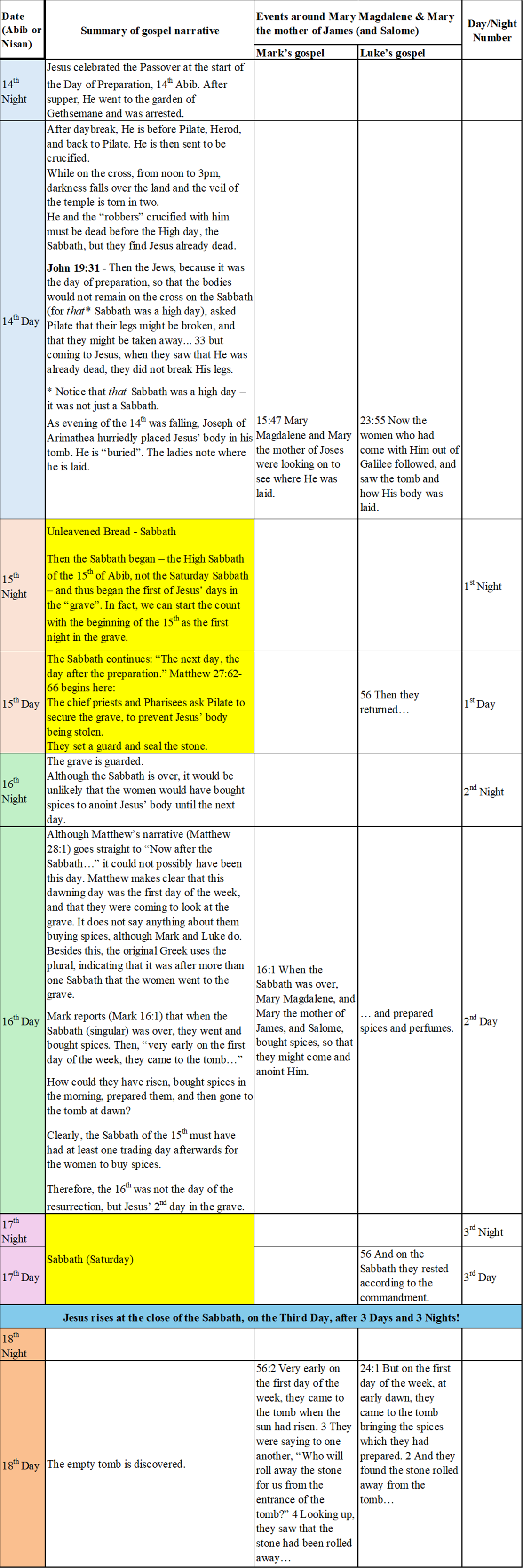
Counting back from 18th Abib as “the first day of the week” (i.e. Sunday), makes the 14th Abib, the beginning of the feast of Unleavened Bread, the Passover, and the death of Jesus, as a Wednesday.
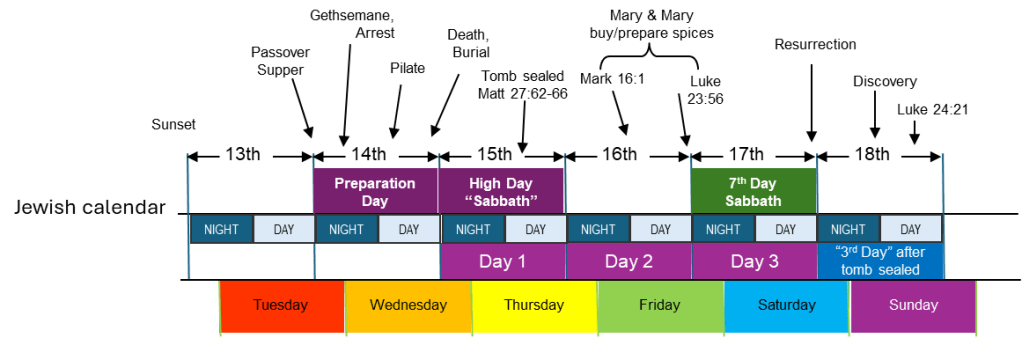
Died on Wednesday. Rose on Saturday.
Here is a simplified view of the timeline:
Is this important? What does it matter?
Apparent inconsistencies in God’s word can only erode our faith in its divine inspiration. If we are to trust in the account of Jesus’ death and resurrection as an accurate historical account, then we cannot allow such glaring inconsistencies the opportunity to be brought out. If we cannot trust the historicity of the account, we cannot trust its significance. The whole of the Bible becomes subject to interpretation.
The story of Jonah is perhaps one of the most loved stories of the Bible, known even by many who have no particular love for the truths of the Bible. It is popular, and its message of God’s forgiveness is a cultural cornerstone. However, many skeptics will try to dismiss its historical nature, for example, by arguing on the species of the “fish” and the possibility of surviving in such a beast for three days. If the story is just a “fairy story”, then what it says is no more than the moral of a fable.
Jesus refers to Jonah as an historical prophet (Matthew 12:41). He also predicts his own death and resurrection and calls it “the sign of Jonah” (Matthew 12:39, 40). Luke adds, “For as Jonah was a sign unto the Ninevites, so shall also the Son of man be to this generation.” Luke 11:30. If Jonah is a fable, then it stands to reason that so too is Jesus!
The parallel between Jonah and Jesus is therefore important. Jonah is not simply a type of God’s forgiveness, but it is a type of Jesus’ resurrection and proclaiming judgement and salvation for sinful people. Jesus is very specific in this parallel: “… just as Jonah was three days and three nights in the belly of the sea monster, so will the Son of Man be three days and three nights in the heart of the earth.”
The story of Jonah is history. Jesus referred to it as history. Jonah was a type of Christ. The “sign of Jonah” was all that Jesus would give the Pharisees: Three days and three nights in the heart of the earth.
If Jesus were not three days and three nights in the heart of the earth, then the sign of Jonah is meaningless.
The one Scripture that appears to support a Sunday resurrection
Luke 24:13-21 And behold, two of them were going that very day (i.e. Sunday; see verse 1) to a village named Emmaus, which was about seven miles from Jerusalem.
14 And they were talking with each other about all these things which had taken place.
15 While they were talking and discussing, Jesus Himself approached and began traveling with them.
16 But their eyes were prevented from recognizing Him.
17 And He said to them, “What are these words that you are exchanging with one another as you are walking?” And they stood still, looking sad.
18 One of them, named Cleopas, answered and said to Him, “Are You the only one visiting Jerusalem and unaware of the things which have happened here in these days?”
19 And He said to them, “What things?” And they said to Him, “The things about Jesus the Nazarene, who was a prophet mighty in deed and word in the sight of God and all the people,
20 and how the chief priests and our rulers delivered Him to the sentence of death, and crucified Him.
21 But we were hoping that it was He who was going to redeem Israel. Indeed, besides all this, it is the third day since these things happened.
Note: They did not say it was the third day since Jesus’ death or crucifixion, but “the third day since these things happened”.
“These things” were the recorded events “concerning Jesus” (v19). They would have included not just the crucifixion and death, but the things witnessed and recorded by the disciples: His entombment, and the placing of the guard and sealing of the tomb. (Matthew 27:62)
The latter two occurred on the Thursday, i.e. the day after the entombment, being the first day and after the first night. The third day after this event would have been the Sunday, when the two disciples met Jesus on the road to Emmaus.
This is the only explanation. From the point of view of Cleopas and the other disciple, it was the third day since the things concerning Jesus took place. From the point of view of Jesus’ promise, his resurrection had taken place on the third day (before the start of the fourth night), and after three days and three nights in the heart of the earth.
Don’t look for problems. Don’t look for excuses. Look for the Truth.
This explanation first came to me via a source that many “mainstream” Christians find questionable at best. I will not name it here, because I don’t want to proactively associate myself with it as there is a lot that this source teaches that I disagree with. Nevertheless, the logic and Scriptural treatment in the article were compelling, and I undertook my own studies to verify the soundness of the argument. I will argue, therefore, that this is the result of my own searching of the Scriptures.
In my discussions with other Christians on the subject, most would revert to three unshakable bastions of their continued adherence to the Good Friday – Easter Sunday “doctrine”, all coming under the general banner of “This is what my church teaches,” not to be questioned:
- All of the mainstream Christian churches teach it;
- This has been the practice of churches throughout the Christian Era;
- This model can be made to fit the “third day” promise.
The issue of Luke 24:13-21 was never brought up in my discussions: I came across this on my own and had to wrestle with it myself. Again, the “solution” of identifying “these things”, “concerning Jesus of Nazareth,” was presented by the source I mentioned before, and although (as I said) I disagree with much of what the source teaches, the solution was simple and logical.
More importantly, however, my research was driven by a strong belief that the Scriptures as preserved through the ages and presented to us today are essentially correct and consistent.
Cleopas describing Sunday as the third day since “these things were done” is perfectly reasonable and consistent.
The “third day” being the Sunday after Good Friday or the end of Saturday after the Wednesday/Thursday are both reasonable and consistent scenarios, to varying degrees as discussed.
What is not perfectly reasonable and consistent is the idea that Jesus’ clear statement in “the sign of Jonah” (3 days and 3 nights) somehow be forced into the Good Friday/Easter Sunday scenario.
What is also not at all reasonable and consistent is the glaring inconsistency between Luke’s gospel and Mark’s gospel: the first stating that the women prepared spices before the Sabbath and the second that they bought the spices after the Sabbath. This kind of inconsistency undermines the reliability of the New Testament.
The simple solution is given. The “Lord’s Supper” was clearly the celebration of the Passover. The Passover meal was celebrated before the Feast of Unleavened Bread, and was a “Sabbath”, with a preparation day in between. The original Greek uses the word “Sabbaths” (plural) for Matthew 28:1. That is the only way the women can buy spices before a Sabbath and after a Sabbath at the same time!
To summarize:
- Jesus died at sunset, the end of Wednesday 14th Abib and buried at the beginning of the 15th (just after sunset).
- Jesus rose by the end of 17th Abib, a Saturday, before sunset.
- His tomb was discovered on 18th Abib, just around dawn but several hours into the Sunday.
- The first day was Thursday, 15th Abib and the third day was Saturday, 17th.
- Jesus was in the “grave” for 3 days and 3 nights (of the 15th, 16th and 17th Abib).
 New Earth Christian Studies